
Today Microsoft announced the general availability of Copilot Cowork, and this is a bigger shift than it might seem at first glance.
For the past year, most organizations have been getting comfortable with Copilot as an assistant. It helps draft emails, summarize meetings, and answer questions. That’s valuable…but it doesn’t quite meet the mark for an organization looking for a transformation tool.
Copilot Cowork represents something different.
This Isn’t Just Faster Work—It’s Less Manual Work
The real shift here isn’t speed, it’s reduction.
Instead of simply accelerating tasks, Copilot Cowork allows organizations to remove work altogether—specifically, the manual, multi-step effort that typically spans across applications.
With Copilot Cowork, you can now:
- Delegate multi-step tasks
- Work seamlessly across tools like Teams, Outlook, and SharePoint
- Receive completed outcomes—not just suggestions
Remember all the marketing videos about AI being your co-collaborator? This is finally the shift that moves AI from being something you consult to something you assign work to.
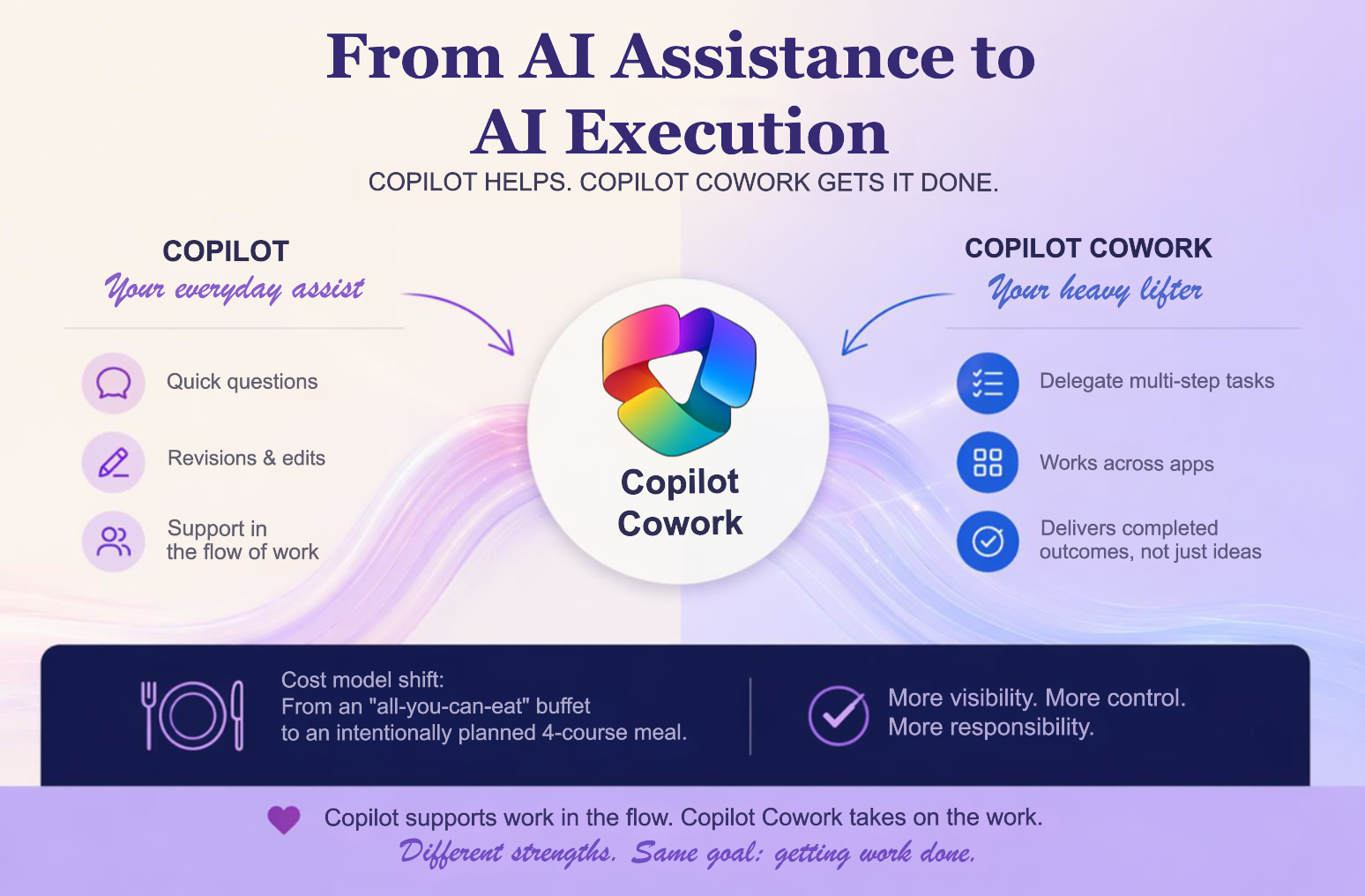
To really understand the impact, it helps to think about how roles are changing. Copilot still plays an important role—but it stays focused on supporting work in the moment. Things like answering quick questions, making revision, keeping tasks moving forward, etc. Copilot Cowork steps into a different lane entirely:
- Taking ownership of more complex work
- Executing across systems
- Delivering finished outputs
A simple way to think about it:
Copilot helps with the quick, in-the-moment needs to keep things on track, while Copilot Cowork is the one you hand things off to when you need real help getting something fully done.
The Cost Model Shift: From Unlimited to Intentional

For organizations already experimenting with Copilot Cowork through Frontier, there’s another important change to pay attention to: pricing. Microsoft is moving toward a more usage-based model, where cost aligns more directly to consumption.
We’re moving from an “all-you-can-eat” buffet to an intentionally planned four-course meal.
This introduces a few important dynamics:
- Greater visibility into value – You can better understand where AI is driving impact
- More control over spend – With mechanisms to manage usage
- More responsibility – Organizations now need to actively govern how it’s used
The value is still there, arguably even clearer, but it requires more thoughtfulness in how it’s consumed.
What Organizations Should Be Focusing on Now
This shift isn’t just technical, it’s operational. The organizations that see the most value will be the ones that adapt how they think about work.

Here are three questions to prioritize:
- Where are your highest-value use cases?
- Focus on scenarios where execution matters more than assistance: multi-step, time-consuming, cross-functional work.
- Do you have the proper guardrails in place?
- With a consumption-based model, governance matters more than ever. Have you established DLP policies? Set up Sensitivity Labels?
- Microsoft provides the ability to set spend limits at the tenant, group, and user levels—but organizations need to proactively establish this.
- How are you driving behavior change?
- Success will come from shifting how people work, not just giving them access to new tools.
We’re entering a new phase of AI adoption—one where the goal isn’t just to do work faster, but to fundamentally change who (or what) is doing the work.
Copilot still supports work in the flow.
Copilot Cowork becomes the heavy lifter.
And that’s where the real transformation starts.
Check out this Microsoft Blog Post for more information.